
Where Execution Accountability Lives
WRITTEN BY
Fabian Matamoros
Published
Feb 16, 2026
Read time
5 min read
Understanding the structural difference between service delivery and operational integration.
1 | The Question Behind the Contract
In growing organizations, execution eventually extends beyond the boundaries of the internal team.
When that happens, leaders often begin with a cost discussion.
Hourly rates. FTE counts. Budget impact.
But cost is rarely the strategic question.
The structural question is this:
Where does accountability for execution outcomes live?
As workflows become more complex — and more central to business performance — the answer to that question determines whether external execution becomes leverage or friction.
2 | Execution Models Exist on a Spectrum
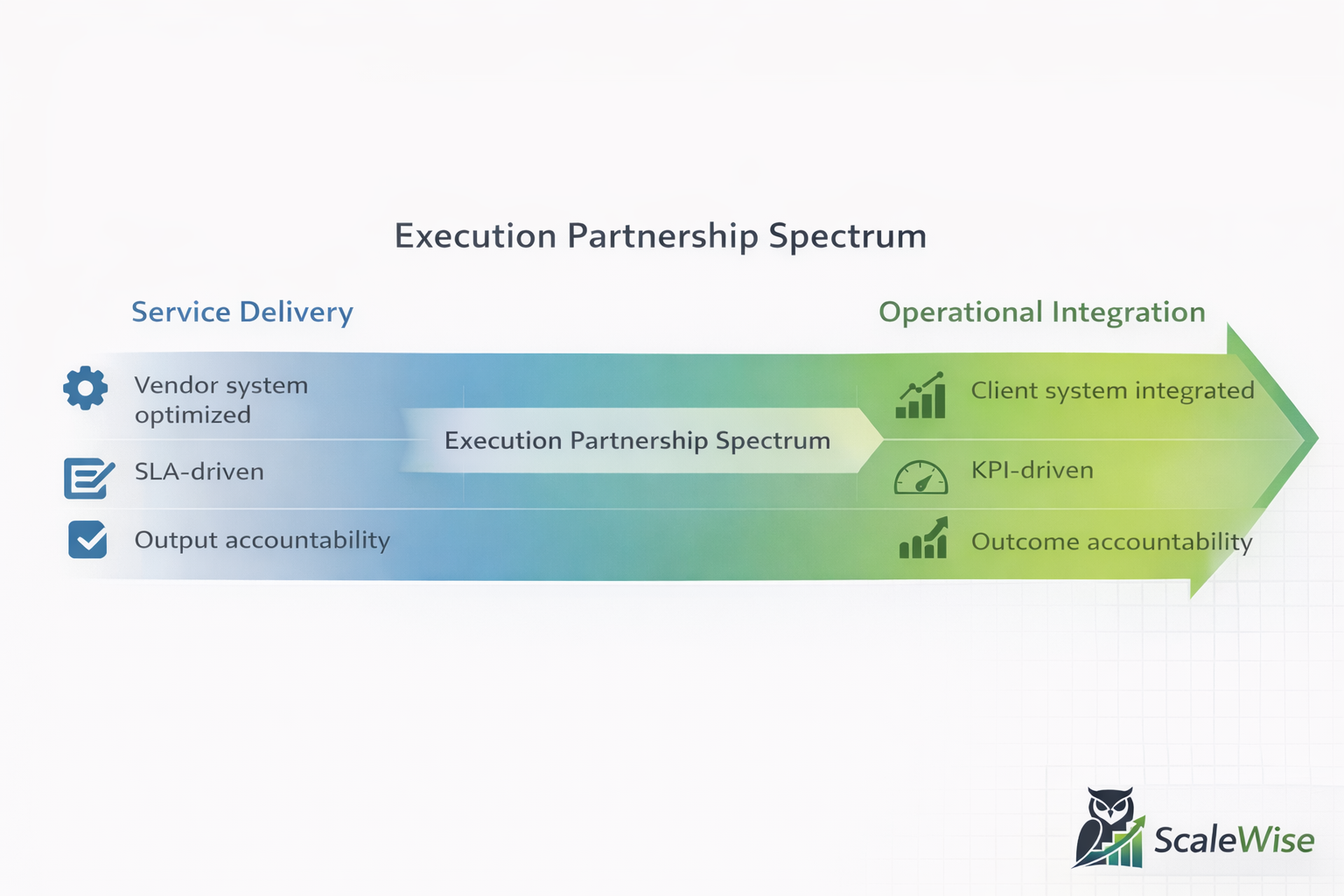
Execution partnerships are not binary. They exist along a structural spectrum.
At one end is a service delivery model.
At the other is an operational integration model.
Neither is inherently better.
Both can be effective.
The difference becomes material as workflow complexity increases.
3 | Model A: The Service Delivery Model
The service delivery model is structured around defined outputs.
Core Characteristics
- Vendor optimizes its own internal delivery system
- Success measured primarily through SLAs
- Vendor-managed hierarchy and supervision
- Clearly scoped deliverables
- Defined escalation paths
Where Accountability Lives
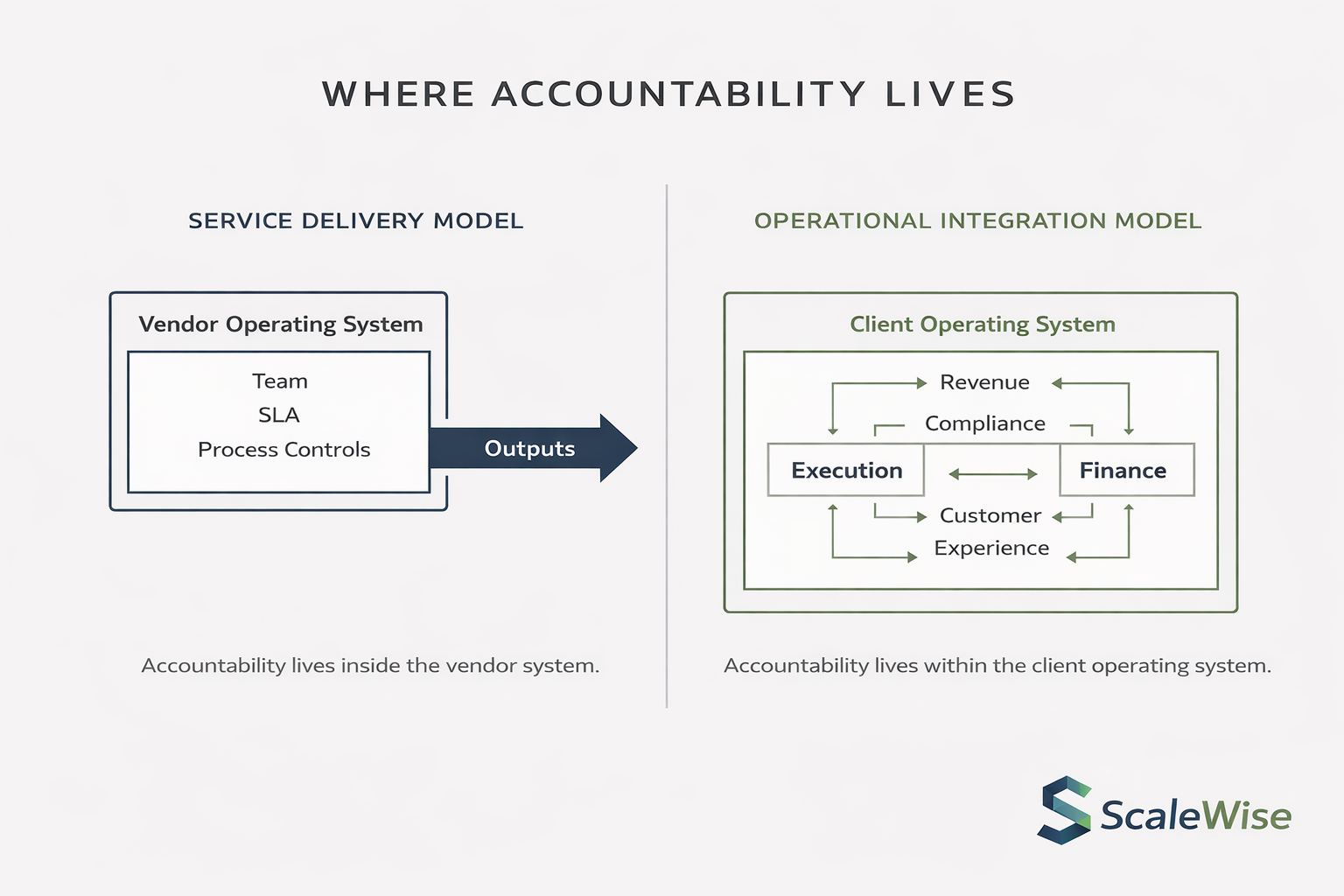
Accountability lives inside the vendor's operating system.
The vendor owns throughput, quality rates, turnaround times, and compliance with predefined service levels.
This model performs well when:
- Work is standardized and repeatable
- Inputs are predictable
- Exceptions are limited
- Output criteria are clearly defined
It provides clarity and structure.
It works particularly well for stable processes.
4 | Model B: The Operational Integration Model
The operational integration model is structured differently.
The external team is not simply delivering outputs.
They are operating within the client's execution environment.
Core Characteristics
- KPIs align to internal business outcomes
- Shared reporting and visibility
- Embedded governance rhythm
- Continuous workflow refinement
- Alignment to evolving priorities
Where Accountability Lives
Accountability lives within the client's operating system, shared through aligned metrics, cadence, and decision frameworks.
The team is accountable not just for completing tasks, but for how execution affects:
- Revenue operations
- Compliance exposure
- Customer experience
- Financial performance
This model becomes critical when:
- Workflows require judgment
- Edge cases are common
- Multiple departments intersect
- Business outcomes depend on nuance
5 | The Distinction Is Structural, Not Philosophical
Both models can include:
- Cost efficiency
- Supervision
- Management layers
- Standardized processes
- SLA compliance
The difference is not professionalism.
It is not competence.
It is not discipline.
The difference is structural:
In one model, accountability lives in the vendor's delivery design.
In the other, accountability lives inside the client's operating system.
That distinction only becomes visible when complexity increases.
6 | When Complexity Changes the Equation
In early growth stages, many workflows remain linear.
As organizations scale, workflows become interdependent.
Complexity introduces:
- More handoffs
- More exceptions
- More internal stakeholders
- More compliance considerations
- More revenue exposure
At that stage, the question is no longer, "Is the work getting done?"
The question becomes, "Is the work improving the system?"
That is where structural alignment matters.
7 | Operational Insight: Execution Design Reduces Headcount
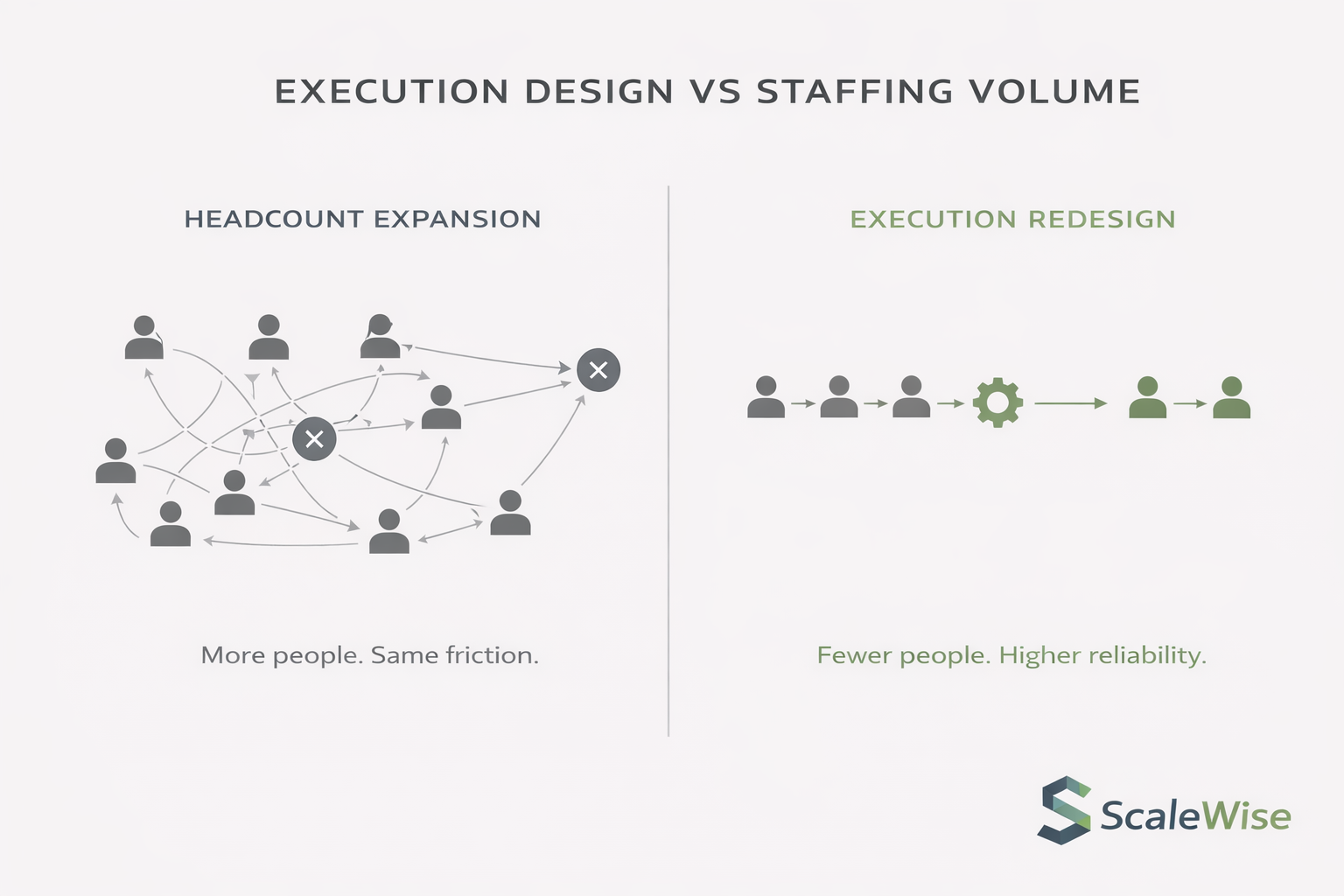
One of the most common misconceptions in execution partnerships is that improvement requires more people.
In practice, structural redesign often reduces required headcount.
Across multiple environments — public sector, healthcare, call centers, software delivery — a recurring pattern emerges:
When process design improves, staffing pressure decreases.
What Typically Drives That Shift
- Bottleneck identification
- Workflow redesign
- Task realignment
- Volume-based personnel allocation
- Automation of repetitive tasks
- Elimination of unnecessary handoffs
The goal is not headcount expansion.
The goal is execution reliability and efficiency.
In fact, some engagements that begin resembling a traditional service delivery structure transition into leaner operating models once workflows are clarified.
Execution design matters more than staffing volume.
8 | Structural Examples from Practice
Example 1: Municipal Operations Reform
In a municipal cleaning department operating under severe budget constraints, performance issues were initially framed as a staffing shortage.
Inspection teams were overwhelmed.
Complaint backlogs were rising.
But analysis showed something different.
- Inspection routes were not prioritized by impact.
- Penalty issuance lacked standardized review thresholds.
- Daily field deployment had no KPI rhythm.
No new hires were added.
Instead:
- Daily execution metrics were introduced.
- Route sequencing was redesigned.
- Decision authority was clarified.
Capacity increased without expanding headcount.
The change was structural — accountability shifted from reactive task completion to measurable operational outcomes.
Example 2: Contact Center QA Instability
In an ecommerce campaign, quality assurance performance was deteriorating.
The initial response was to increase QA staffing.
Yet error rates persisted.
Upon review:
- Review cadence lacked alignment with campaign velocity.
- Escalation loops were unclear.
- KPIs were output-based, not outcome-based.
Rather than adding personnel, the structure changed:
- KPIs were tied directly to campaign conversion performance.
- QA checkpoints were integrated into campaign planning cycles.
- Supervisory cadence aligned with performance windows.
Headcount remained stable.
Quality stabilized.
Client confidence increased.
Again, the shift was structural — accountability moved closer to business outcomes.
Example 3: Hospital Startup Operations
During a hospital launch phase, equipment readiness issues were attributed to insufficient biomedical staff.
Yet the deeper issue was coordination.
- Procurement timelines were disconnected from construction progress.
- Clinical teams were not looped into equipment training windows.
- Maintenance protocols were reactive rather than scheduled.
By integrating operational planning across departments — rather than increasing technicians — startup stability improved.
Execution accountability moved from isolated task completion to cross-functional integration.
9 | A Practical Lens for Leaders
For Heads of Operations and RevOps leaders evaluating execution partnerships, the decision is not ideological.
It is structural.
Consider:
- How judgment-based is the workflow?
- How often do edge cases occur?
- How tightly is execution tied to revenue or compliance risk?
- How frequently do priorities evolve?
- How much shared visibility is required?
If work is stable and repeatable, service delivery may be optimal.
If work is evolving, cross-functional, and outcome-sensitive, deeper integration may be necessary.
10 | Accountability Determines Leverage
As organizations grow into the 1,000–5,000 employee range, execution complexity increases.
The question is no longer:
"Can someone complete the tasks?"
The question becomes:
"Where does accountability for business outcomes live?"
Execution partnerships succeed when their structure matches workflow reality.
Cost matters.
Efficiency matters.
But structural accountability determines whether execution becomes leverage — or friction.