
Execution Is the Bottleneck (Not Strategy, Not Talent)
WRITTEN BY
Fabian Matamoros
Published
Feb 6, 2026
Read time
5 min read
Most scaling problems don’t start with bad strategy.
They don’t start with weak leadership.
They don’t even start with talent gaps.
They start when execution capacity quietly stops keeping up with the business.
By the time this becomes obvious, the symptoms look familiar:
At that point, companies often reach for the usual explanations:
We need better people.
We need clearer priorities.
We need to realign the team.
Sometimes those things help. Often, they don’t — because they’re addressing the wrong constraint.
Strategy scales faster than execution
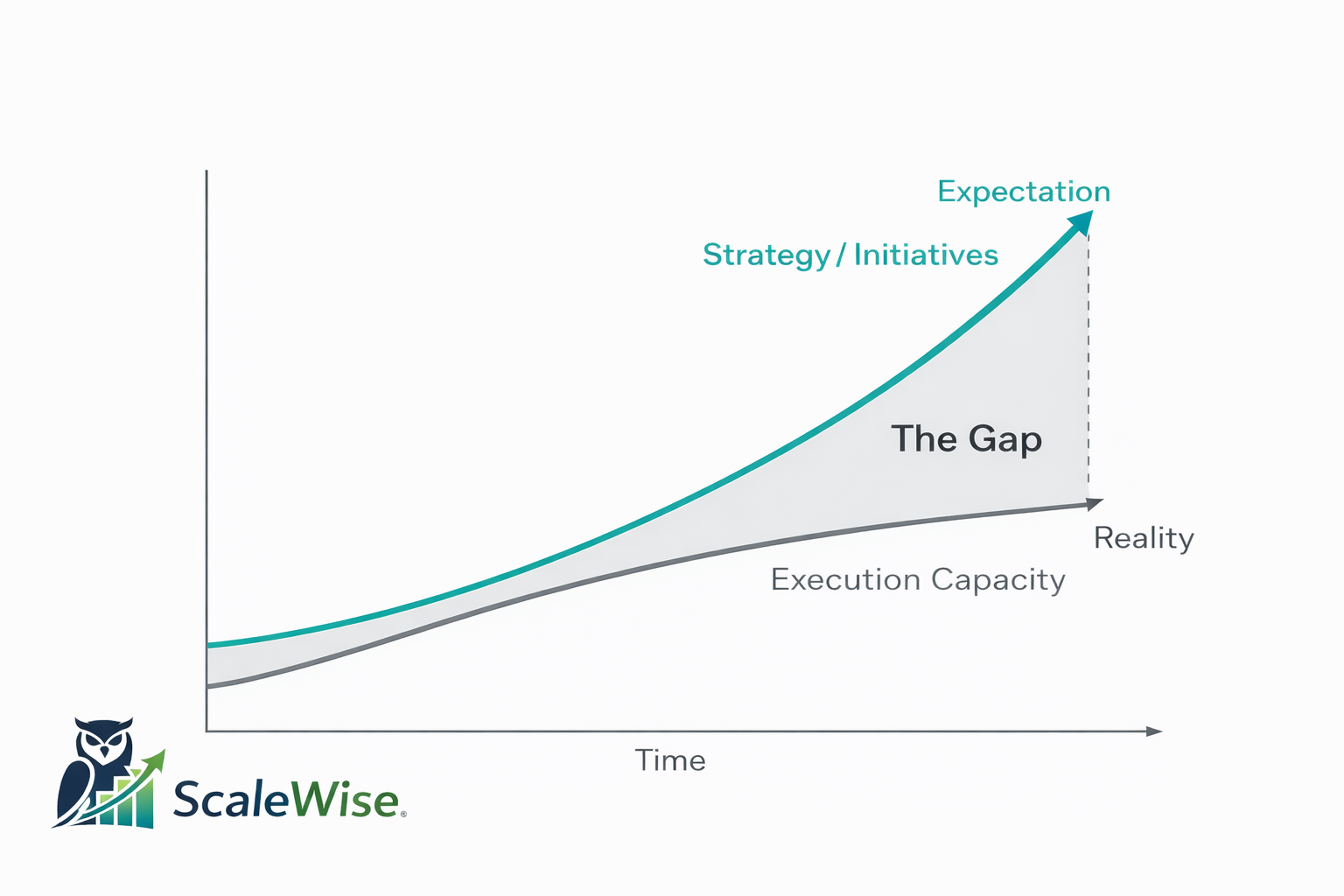
Strategy is cheap to scale.
Execution is not.
You can:
- Launch new initiatives in a planning session
- Approve new priorities in a deck
- Reorganize ownership on paper
But execution lives in reality:
- In queues
- In handoffs
- In review cycles
- In exception handling
- In human attention
As volume increases, execution doesn’t fail all at once. It degrades gradually — and quietly.
Most organizations don’t notice the degradation because work is still getting done. Until suddenly, it isn’t.
The real constraint is execution bandwidth
Execution capacity isn’t just “how many people you have.”
It’s:
Two teams with the same headcount can have wildly different execution capacity.
One produces consistent output with minimal oversight.
The other requires constant intervention to stay on track.
The difference is not effort.
It’s operating design.
What this looks like in practice
Early in my career, I worked in a public-sector enforcement role — the kind of department that exists in every city, doing work that matters but often invisible until something goes wrong.
The environment had all the ingredients for inertia:
- No KPIs to measure progress or outcomes
- No daily or weekly structure — people showed up, but priorities were unclear
- No clear supervision or accountability cadence
- No shared understanding of purpose beyond the broad mandate
The department functionally existed. People were employed. Work was technically happening.
But execution capacity was near zero.
The intervention wasn’t dramatic. It was structural:
- Clear daily and weekly agendas so everyone knew what "done" looked like
- Defined goals per day and per week, tied to the mandate
- Training focused on both the rules and their intent — so judgment could be applied when the manual didn’t cover it
- Daily standups reinforcing outcomes and accountability, not status theatre
There was no major headcount increase.
Capacity increased through structure, clarity, and cadence.
I’ve seen this pattern repeat across very different environments.
Why this shows up after success — not before
Early-stage teams often mistake momentum for scalability.
At low volume:
- Informal processes work
- Heroics fill the gaps
- People remember edge cases
- Errors are visible and fixable
As volume increases:
- Memory stops scaling
- Exceptions multiply
- Coordination costs rise
- Quality becomes harder to inspect
- Managers become bottlenecks
Nothing “breaks” in a dramatic way.
Things just start taking longer, requiring more checking, more follow-ups, more meetings.
This is the point where execution — not vision — becomes the limiter.
Adding people doesn’t automatically add capacity
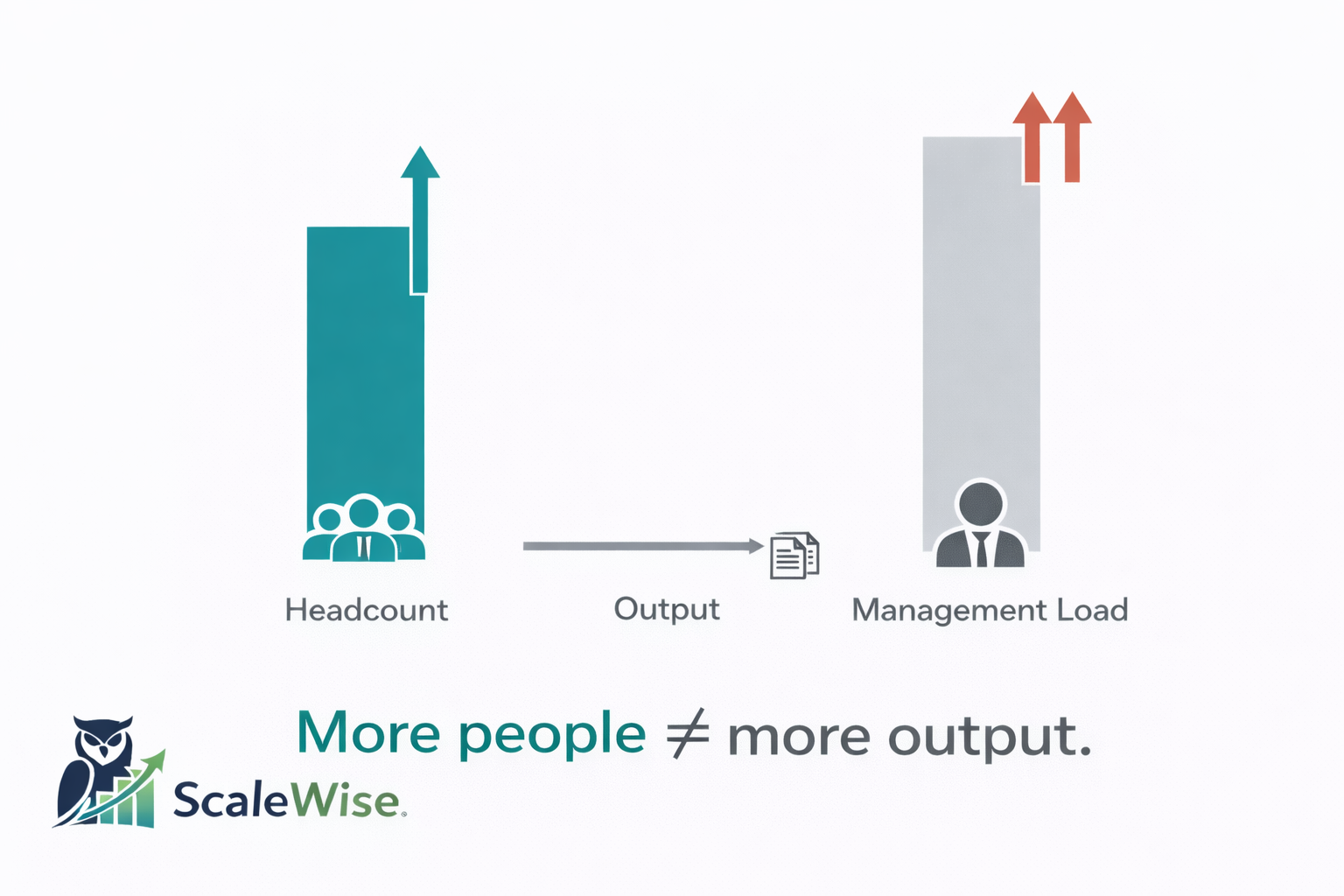
The most common response to execution strain is headcount.
Sometimes that works. Often it doesn’t.
Why?
Because adding people without changing the operating model:
Throughput stalls. Management load increases. Visibility decreases.
From the outside, it looks like a performance issue.
Internally, it’s a capacity design problem.
A concrete example: I once helped restructure a QA function for a customer service operation tied to ecommerce. The initial problem was familiar.
Headcount had been added repeatedly. Throughput and quality weren’t improving. Management load kept rising — more people to coordinate, more handoffs, more confusion about what “good” looked like.
The structural fix wasn’t more people. It was an operating model:
- Clear KPIs to identify bottlenecks instead of guessing
- A weekly operating cadence — early in the week, grading interactions; later in the week, structured feedback to agents
- Training QA staff on goals and intent, not just checklists, so they could calibrate judgment
- A monthly review cadence with the client to align expectations and adjust the process
The solution was not more people.
It was structure — reducing randomness, management drag, and the need for constant intervention.
Execution capacity is designed, not hired
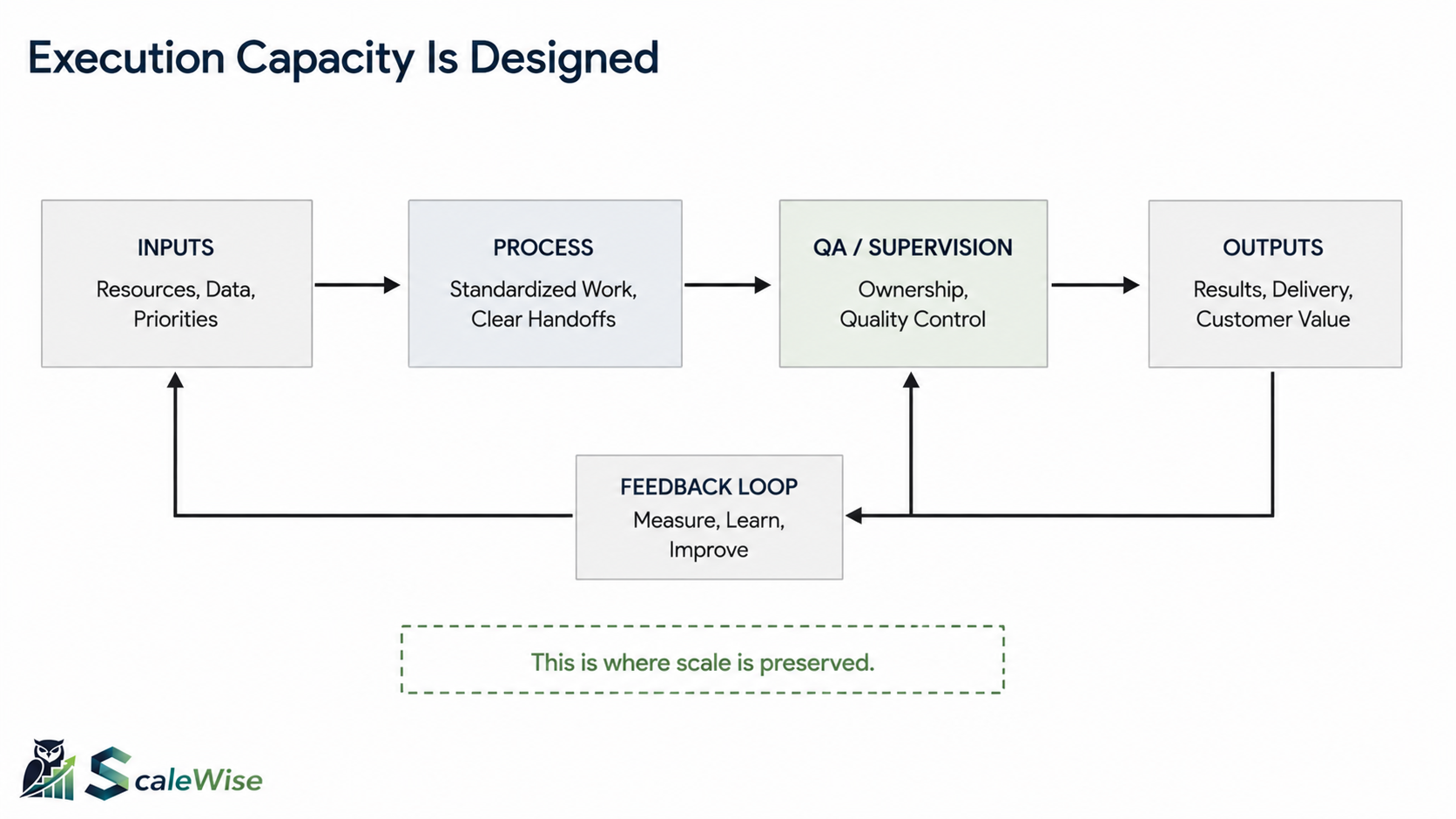
High-functioning operations don’t rely on individual excellence to scale.
They rely on:
When those elements are in place, execution scales with confidence.
When they aren’t, leadership compensates with micromanagement — until that stops working too.
Why this matters now
For companies in the 1,000–5,000 employee range, this is a critical inflection point.
You’re big enough that:
But you’re not so large that inefficiency is absorbed by sheer scale.
This is where execution capacity becomes a strategic issue — whether leadership labels it that way or not.
The quiet truth
Most operational challenges aren’t caused by poor decisions.
They’re caused by systems that can’t reliably carry the load placed on them.
Until execution capacity is addressed deliberately, no amount of strategy refinement will fix downstream friction.
Execution isn’t the afterthought of growth.
It’s the constraint that determines whether growth is sustainable at all.